Unsupported Browser
Hello! We’ve noticed that you are using Internet Explorer to access our site. This browser is no longer supported. Please switch to another browser and try again.
Hello! We’ve noticed that you are using Internet Explorer to access our site. This browser is no longer supported. Please switch to another browser and try again.
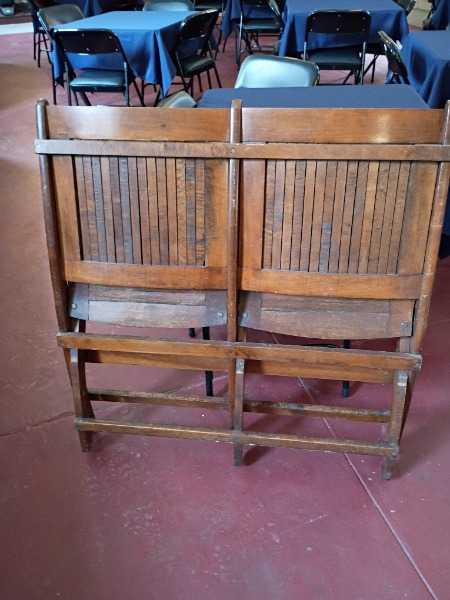
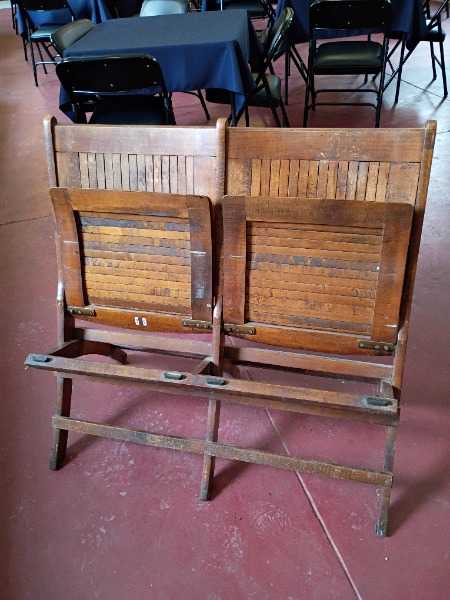
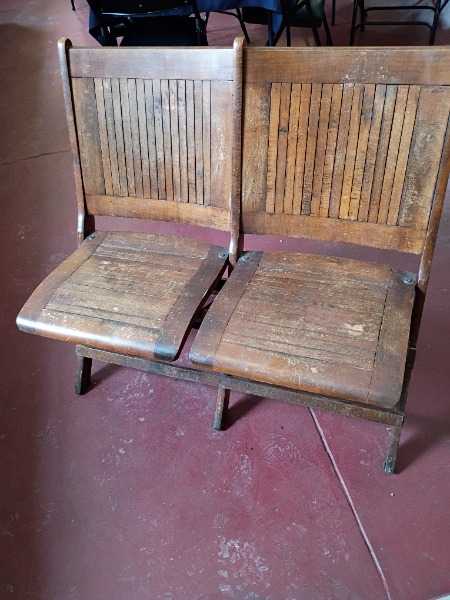
ANTIQUE OAK DOUBLE FOLDING AUDITORIUM BENCHES Circa 1905–1920 Set of 12 Matching Units (24 Seats Total)
Offered by the Historical Society of Frankford
1507 Orthodox St
Philadelphia, PA 19124
These early 20th-century solid oak double folding benches were originally designed for church, lodge, or school assembly use. They retain their original construction and patina.
FEATURES • Solid oak construction (quarter-sawn grain visible) • Slatted backs and seats • Folding scissor-brace base • Original strap hinge hardware • Designed for modular row installation
CONDITION • Structurally sound • Original finish with institutional wear • Fully functional folding mechanisms
IDEAL FOR • Church overflow seating • Event venues • Restaurants and breweries • Theater lobby seating • Historic interpretation settings • Film or stage use
QUANTITY AVAILABLE 12 matching double benches Total seating capacity: 24
Local pickup preferred.
Contact: Michael McCormick
mike@thsof.org
216-650-3929
Research Notes
Based on the construction details visible in the photographs, this appears to be an early 20th-century American double folding “auditorium” or “opera house” chair, sometimes called a portable pew bench.
Key Identifying Features
From images:
Double-width configuration (factory-built as a pair, not two chairs joined later)
Slatted seat and back panels
Quarter-sawn oak grain (very typical of c. 1900–1925 institutional furniture)
Heavy steel strap hinges
Folding scissor-style base
Fixed back frame with separate folding seat panels
Metal cup/bracket plates on the front rail (often used for floor anchoring or linking rows together)
These features are consistent with portable church, lodge, school, or lecture hall seating made roughly between 1900 and 1930.
Most Likely Manufacturer
Without a stamp or plate, attribution can only be stylistic and construction-based. The strongest candidate would be:
1. American Seating Company (Grand Rapids, MI)
The largest U.S. manufacturer of church, school, and theater seating.
Produced portable folding pew units and lodge seating.
Quarter-sawn oak versions were common before WWI.
Date Estimate
Based on:
Joinery style
Hardware type
Slat proportions
Wood selection
Estimated production: circa 1905–1925